Will Players Face Increased Injuries After Club World Cup?
As the new season heats up, concerns arise about potential injury crises for teams such as Chelsea, Paris Saint-Germain, and Real Madrid. All three clubs have experienced a troubling number of injuries early in this season after competing in the extended FIFA Club World Cup, which Chelsea won on July 14.
This year marks an unprecedented scenario in club football, with seasons stretching well beyond May, apart from the pandemic interruptions in previous years. Club medical teams face unprecedented challenges in keeping their players fit.
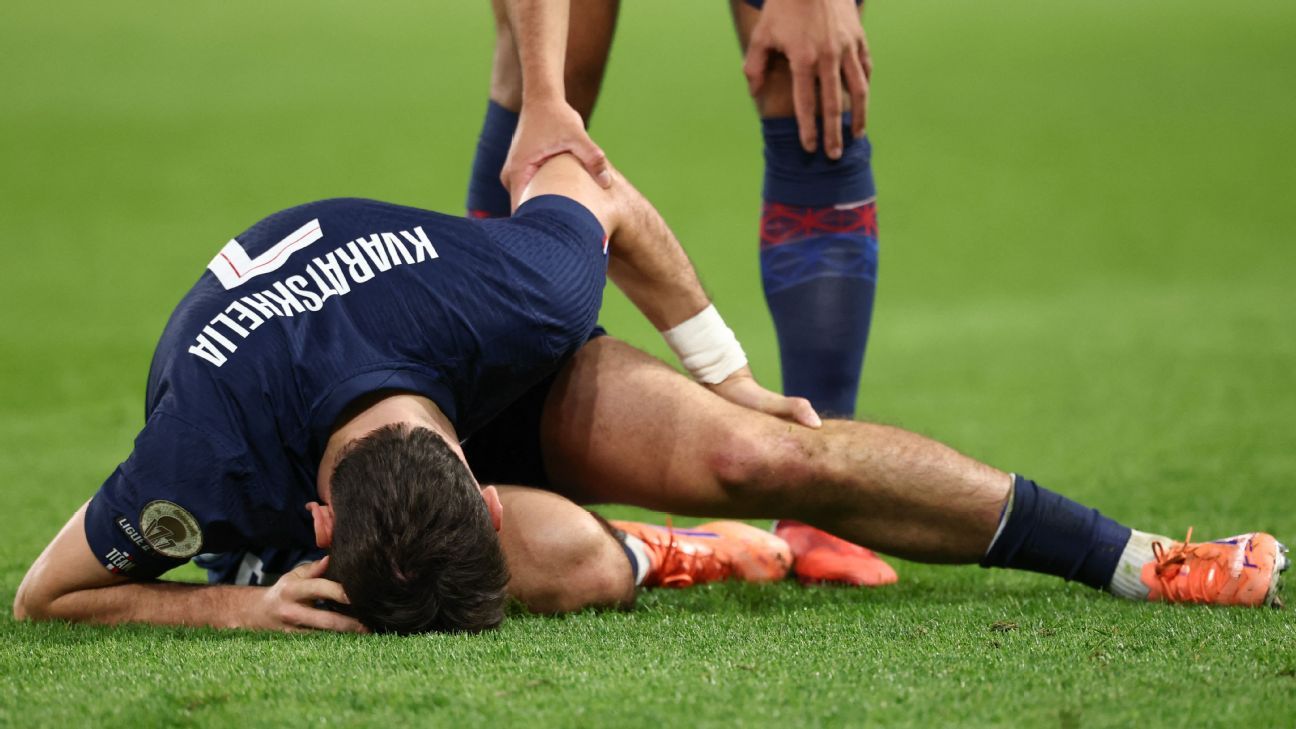
PSG faced Barcelona this month in a highly anticipated Champions League matchup, but the absence of five key players who contributed to their 5-0 win against Inter Milan in May impacted the game significantly. The sidelined players include Ousmane Dembélé, Désiré Doué, Khvicha Kvaratskhelia, João Neves, and Marquinhos.
A few days later, Chelsea supporters were disheartened as Benoît Badiashile and Josh Acheampong exited a thrilling 2-1 victory against Premier League champions Liverpool due to injuries. Their absences only add to an already daunting injury list: Cole Palmer is struggling with his second muscle strain, Liam Delap has a Grade 2 hamstring tear, and Dário Essugo underwent thigh surgery. Additionally, Tosin Adarabioyo, Wesley Fofana, and Andrey Santos missed the match due to issues, while Levi Colwill’s ACL tear has sidelined him for most of the season.
– Tighe: How ‘Little Messi’ Estêvão rose from Palmeiras to Chelsea
– Hunter: Why Spain’s player production line is the envy of the world
– 2026 World Cup squads ranked: All 87 national teams that could win
Real Madrid has navigated injuries slightly better but faced their own set of challenges, having dealt with a mini-crisis at the right back position as Dani Carvajal struggles with fitness, and newcomer Trent Alexander-Arnold has already experienced a Grade 2 hamstring injury.
Fluminense, another semifinalist in the Club World Cup, has managed to avoid similar pitfalls due to their domestic league schedule, which runs from March to December. They entered the tournament mid-season, in good condition, thanks to their larger squad capable of withstanding the typical demands of Brazilian Serie A (using 37 players so far).
However, while Fluminense had the advantage of preparation, Chelsea, PSG, and Real Madrid found themselves at a disadvantage due to scheduling conflicts stemming from the Club World Cup, raising questions about the reason behind their injury woes.
A Tough Reality
Chelsea’s triumph over PSG in the Club World Cup final wrapped up a long 355-day season for the Blues and 357 days for PSG. Shortly after, both clubs commenced their preseason training in early August, and Chelsea’s Colwill unfortunately ruptured his ACL on the first day.
The Blues managed to schedule two friendlies back-to-back during a brief two-week lead-up to the start of the Premier League season, which began against Crystal Palace. Conversely, PSG opted to commence their season even earlier, indulging in the chaotic UEFA Super Cup final against Tottenham on August 13, ultimately sealing a win in a penalty shootout after a 2-2 tie.
Real Madrid’s preseason was similarly condensed, only playing one friendly against Austrian side WSG Tirol while having their first LaLiga fixture against Osasuna pushed to a Tuesday due to insufficient preparation time compared to the other clubs.
ESPN analyzed the demanding schedules of Chelsea, PSG, and Real Madrid, receiving varied reactions ranging from disbelief to serious concern from professionals in the field.
Paul Bower, a performance coach with CF Montréal and a researcher in training methodologies, expressed astonishment at the current situation, emphasizing the unprecedented nature of the unique challenges posed by the Club World Cup.
“Teams were not equipped to handle such an extensive offseason with players carrying the fatigue of a long campaign. They need time to physically and psychologically reset,” he explained. “Two to three weeks off isn’t sufficient for proper recuperation.”
Bower urges that medical departments had to estimate suitable training schedules, acknowledging that no perfect solution exists for these overwhelming challenges. He refuses to allocate blame to the clubs involved, expressing the scenario is inherently complex.
Dave Carolan, a seasoned sports science expert and advisor to FIFPro, supports Bower’s concerns, stating, “Despite having vast resources, the human body’s capacity has limits. Balancing rest and preparing for the new season left teams caught in a difficult bind, impacting the essential retraining period.”
The Ideal Preseason Plan
Preparation for the upcoming season varies among clubs, with larger teams bearing additional commercial responsibilities that can extend their travel schedules. This imbalance puts them at greater risk for fatigue-related injuries.
Bower concluded that while the responsibility heavily rests on those setting the calendar, the implications for players are serious. Injuries in such congested schedules are expected but remain troubling and foreseeable.
For Chelsea, PSG, and Real Madrid, the current seasons feel more like a single extended campaign. Without adequate rest and recovery, players are essentially enduring their 15th month of competitive play instead of their third.
n